

An international YouGov study shows national publics differ greatly in their assessments on the impact that AI has had so far
Key takeaways
- Survey conducted in nine countries – Australia, Britain, Canada, Denmark, France, Germany, Italy, Spain and USA – finds those in Anglosphere nations more negative about AI
- Majorities in most countries say that more jobs will be lost to AI than will be created
- Publics are most positive about the impact of AI on healthcare, and on day-to-day leisure and work tasks
- They are typically most negative about the impact on jobs, news media, and older people
A new international YouGov shows that English-speaking countries are consistently more likely to be negative about artificial intelligence than those in the Western European countries we surveyed.
Our poll covered nine Western countries, four of which we refer to as ‘English-speaking’ countries (Australia, Britain, Canada and the USA), while we refer to the other five as ‘Western European’ (Denmark, France, Germany, Italy and Spain).
Overall sentiment towards AI
Opinion towards AI is divided among all the countries we surveyed. Between 33-40% say they have a neither positive nor negative view of the technology, while among those with explicitly positive or negative views, Western Europeans tend to skew slightly more positive and English-speaking nations are typically more negative.
Spaniards prove to be the warmest regarding AI, with 37% describing their overall attitude towards the technology as positive, compared to 21% saying negative.
At the other end of the table, 38-39% of Britons and Americans hold an unfavourable view of AI, compared to 25% with a favourable one.
When asked more specifically on whether AI will bring more benefits than drawbacks, responses do begin to vary a bit more.
Spaniards in particular prove likely to say that the pros of AI will outweigh the cons, with 49% saying so, alongside 42% of Danes.
The English-speaking nations surveyed remain rooted to the bottom of the table. Only 25-28% in Australia, Britain, Canada and the USA think the benefits are likely to outweigh the drawbacks. By contrast, 31-36% think the negatives will outweigh the positives, notably higher than among the Western Europeans surveyed (14-27%).
The expected impact of artificial intelligence on jobs
Looking more specifically again at the impact Westerners expect AI to have on jobs, there is much more widespread pessimism. In each country surveyed, the most common answer by far (45-66%) is that more jobs will be lost because of artificial intelligence than will be created.
Again, English-speaking nations tend to cluster at the bottom of the table, with Britons and Australians coming joint bottom at 66% thinking AI will destroy more jobs than it creates.
Only 6-14% in each country expect AI to produce more jobs than it makes obsolete, while 11-23% think the balance will be about even.
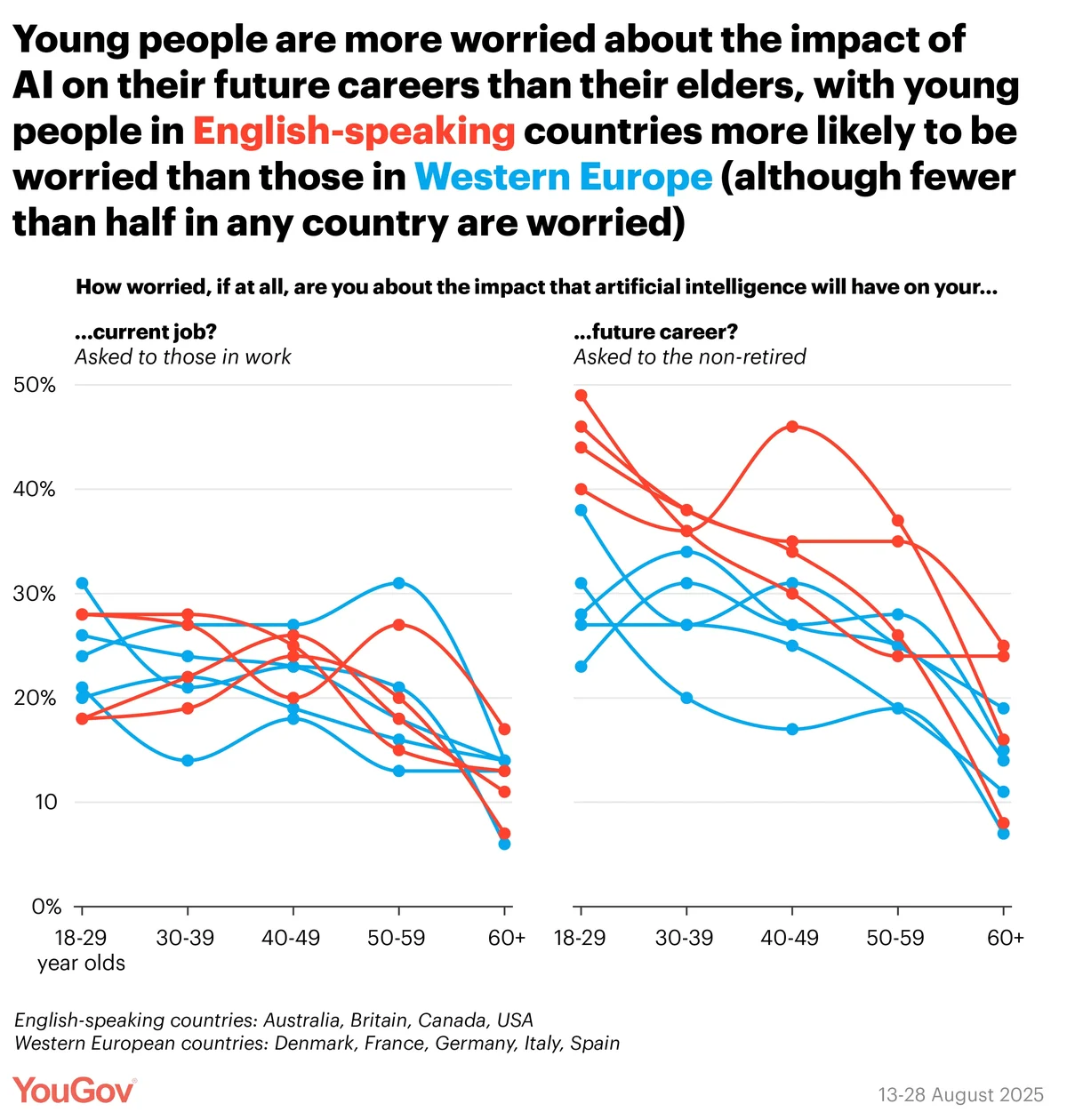
When it comes to their own jobs specifically, Westerners are more nonchalant. The large majority (67-80%) who are currently in work in each country say they aren’t worried about the impact that AI will have on their current job. Only 16-27% say they are worried, including 3-9% who say they are “very worried”.
On this matter, the English-speaking countries are more evenly spread across the rankings – however, when we ask people about their future careers, the results revert to trend, with Americans, Australians, Britons and Canadians proving more likely to be worried (33-36%) than their Western European counterparts (21-28%).
Nevertheless, most (52-72%) aren’t worried about the impact of AI on their future career either.
Indeed, even among the youngest adults – who are most likely to see their careers impacted by the rise of AI – it is still common to be unconcerned by the technology. Again, the English-speaking vs Western European distinction plays a role: while only the minority of 18-29 year olds in Denmark, France, Germany, Italy and Spain (23-38%) say they are worried about the impact of AI on their future careers, this rises to 40-49% in Australia, Britain, Canada and the US. This typically means that there are as many young people in Anglophone countries who are worried as there are unworried, except in the US where the number concerned is higher than the number untroubled by 10pts.
Nevertheless, when it comes to their current jobs, young people are still much more likely to be unworried (61-81%) than worried (18-31%).
What impact do Westerners think AI is having across 17 areas?
Attitudes to the impact that AI has had so far differ significantly by area. There is consistently positive sentiment towards the effect that artificial intelligence has had on healthcare and medicine, with positive net scores of between +21 and +50 in each country surveyed.
Also highly rated are the impact on the ease and convenience of day-to-day workplace activities (+15 to +50) and daily life activities (+17 to +52).
There are also net positive scores across the board – albeit at much lower rates – for transportation and fighting crime. Germans in particular stand out on these issues, having a much more positive score than all other countries: in the case of transportation Germans are on +43 compared to between +8 and +26 everywhere else, and +39 on fighting crime versus a score of +2 to +14 in all other countries.
At the other end of the table, there are overall net negative perceptions about AI’s impact in all countries surveyed when it comes to peace and security; dating and romance; national democracy; the effect on older generations; and news and the media.
Coming at the very bottom overall in average terms is the perceived impact on job security – although this is also the issue which most divides the nations surveyed. Britons stand at the most negative end of perceptions with a net score of -56, but in Italy and Spain there are actually marginally positive net scores of +6 and +10.
The only other area with a comparably large disparity is the impact on creative culture – again, Britons prove to be the most negative (-25) and are counterbalanced by positivity among Italians (+17) and Spaniards (+30).
Again, across all 17 areas we asked about, we see the trend of greater negativity across the English-speaking countries surveyed compared to their Western European peers.
How many Westerners say they use AI?
At the time this survey was conducted in August 2025, the proportion of people in each country saying that they ever used AI for leisure or personal reasons sat between 54% and 71%, including between 11-19% who did so on a daily basis.
Among workers and students we see similar numbers using AI for employment or study purposes: between 54-71% ever used it, and 13% to 22% did so on a daily basis.
An AI apocalypse features low on the list of likely causes of human extinction
While reporting on artificial intelligence can sometimes focus on apocalyptic angles – with warnings that AI could wipe out humanity – relatively few Westerners see robots and/or AI as a top-three likely cause of human extinction.
Only 9-16% included it in their selection from our list, far behind first placed ‘nuclear war’, which was picked by 53-65% in each country.
Interested in taking YouGov surveys? What do you think about artificial intelligence, the impact it is likely to have on jobs, and everything else? Have your say, join the YouGov panel, and get paid to share your thoughts. Sign up here.
Interested in commissioning YouGov research? We connect in real-time with real people around the world to gather their thoughts, behaviours, and opinions, to ensure that our research data is powered by reality. Explore our survey services here.
Photo: Getty